
Nuclear Weapons
DSP connects journalists reporting on nuclear nonproliferation negotiations
More than 70 journalists from around the world participated in the Developing Story Project’s RevCon Reporters Group to follow and report on the eleventh Review Conference of the Parties to the Treaty on the Non-Proliferation of Nuclear Weapons.
Top Photo: The 2026 Review Conference of the Parties to the Non-Proliferation Treaty in session at the United Nations, New York, NY, April 28, 2026. (UN Photo/Manuel Elías)
The expiration of the New START treaty in February removed the last legal constraint on strategic nuclear arsenals at a time when simmering and active conflicts continue to flare up around the world. The Non-Proliferation Treaty (NPT), which went into effect in 1970, remains the only multilateral treaty committed to the goal of disarmament by nuclear-weapon states. It has 191 signatory states, and the parties meet to review the Treaty every five years.
The Review Conference (“RevCon”) presents a challenge for journalists with little experience covering nuclear weapons issues, because of the technical nature of a treaty review process, and because it is a tough sell to editors: a monthlong conference where much of the action occurs behind closed doors, and that may or may not result in a headline-producing consensus. Despite the stakes of nuclear weapons and the importance of the NPT, few journalists attend or report on the conference.
The Developing Story Project (DSP), launched last spring by the journalism and media team at the Stanley Center for Peace and Security as a multi-year effort to support and sustain reporting on nuclear weapons and related issues, seeks to ease these challenges and lower the barrier to entry for journalists interested in better understanding and covering nuclear issues.
In April, the team created the RevCon Reporters Group as a new model of virtual/hybrid programming to support a large cohort of journalists from across the globe who wanted to learn alongside peers while tracking and reporting on the month-long NPT Review Conference, which convened April-May 2026 in New York, NY.
More than 70 journalists from 34 countries were selected from a call for applications and were then invited to join a series of virtual briefings and a dedicated RevCon Reporters WhatsApp chat for info-sharing and exchange during the conference.
Teaming up with Mark Leon Goldberg, a seasoned journalist and host of the Global Dispatches podcast, who has reported on United Nations events for over two decades, the Stanley Center designed a program where Mark was at the UN for key parts of the conference, so that he could follow developments, talk to delegates, and provide rolling updates, analysis, tips, and explainers for journalists covering the conference from afar.
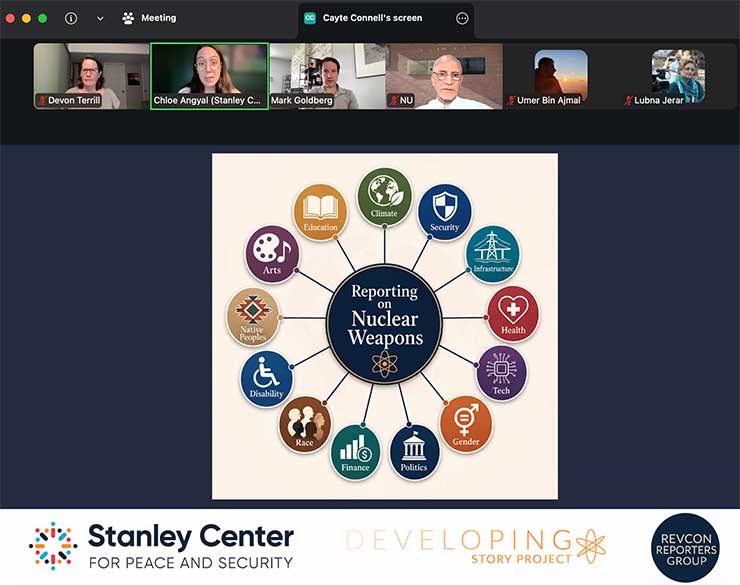
The RevCon Reporters Group met for a series of virtual briefings throughout the conference.
At three points throughout RevCon—on the first day, at the midway point, and on the final day—the Stanley Center held virtual briefings led by Mark, who explained the review process, shared insights from his conversations, pointed to promising storylines, and answered questions from the Group.
Goldberg was on the ground in New York City for the first week of the conference and for the final days, interviewing delegates, civil society leaders, and fellow journalists and transmitting those interviews back to the cohort via the private WhatsApp group. In that group, the journalists could ask Mark their questions about the review process and seek his help finding sources for their reporting. They could share their frustrations and successes and support each other in their work.
Meanwhile, the Stanley Center’s journalism and media team facilitated the briefings, circulated relevant information in the chat, and aggregated useful resources and links throughout the conference to share with the Group after the program concluded.
This program experimented with a new “one person press pool” model of partnering with an expert journalist at an event to serve as a mentor, guide, and briefer for a large global group of fellow journalists. Lessons learned with this new format will benefit future programming by the Developing Story Project and peer organizations.
Journalists that participated in the RevCon Reporters Group dedicated time to improving their understanding of the key features, goals, and challenges of a complex nuclear treaty that is considered the cornerstone of global security. Tuning into the conference also opened discussion about reporting angles, sources, and country-level relevance that will inform future coverage of nuclear weapons issues. It was also meaningful that participants were able to increase their understanding together, in community.
Sign up to receive nuclear weapons journalism and media updates by email to stay up to date on opportunities from the Developing Story Project.