
Nuclear Weapons
Journalists gather for nuclear weapons reporting workshop in Hiroshima, 80 years after atomic bombing
As the world commemorated the 80th anniversary of the first use of nuclear weapons in war, the Stanley Center for Peace and Security’s Developing Story Project gathered 22 journalists from 18 countries in Hiroshima, Japan, for a 4-day journalism workshop, organized as a training and community-building opportunity to strengthen reporting on nuclear weapons issues.
Top photo: Workshop journalists visit the Atomic Bomb Dome in Peace Memorial Park, built on the site of the 1945 atomic bombing in Hiroshima. Photographs by Eugene Hoshiko for the Stanley Center for Peace and Security.
The Hiroshima Journalism Workshop that convened in August 2025 was the first in-person event of the Developing Story Project (DSP). Launched in April, the Developing Story Project is a multi-year initiative of the Stanley Center’s journalism and media program to increase and sustain reporting on nuclear weapons and related issues. Participants of the workshop in Hiroshima were chosen through a competitive application process with an eye to encouraging community across borders, beats, and levels of experience.
“The big question [is] how do we report on an issue that feels abstract to many, yet carries such real risks, in the most impactful way?” reflected Tamara Davison, a freelance journalist based in London and member of the cohort, after the workshop. “Thanks to the organizers, nuclear experts, and the fellow journalists I met this week, I feel like we’ve started to move the needle on that, and I’m very excited for the reporting that will come from it.”
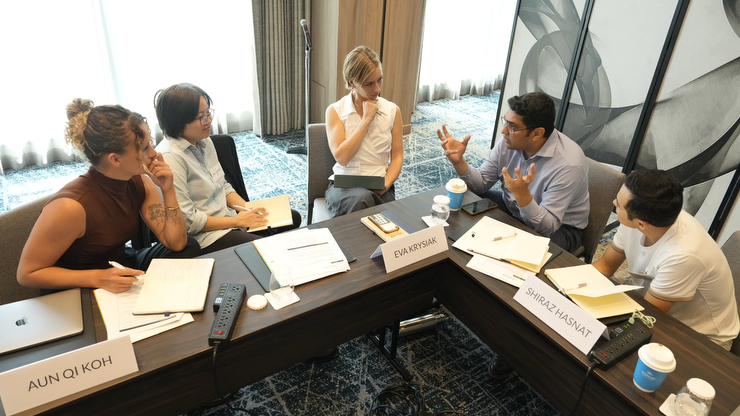
Journalists during a workshop discussion. From left: Tamara Davison, Aun Qi Koh, Eva Krysiak, Shiraz Hasnat, and Manas Kaiyrtayev.
During the four days of the Hiroshima Journalism Workshop, programming included a meeting with atomic bomb survivors, local journalists, and elected officials, as well as peer exchanges, group interviews with nuclear experts, a special screening of a documentary film, and touring the Hiroshima Peace Museum and Peace Memorial Park.
Journalists and editors participating in the workshop met and heard the testimony of two hibakusha–Chieko Kiriake and Koko Kondo, age 15 and an infant, respectively, when the atomic bomb fell on Hiroshima. Both women spoke movingly about their experiences of the bomb and its aftermath, and about their efforts to foster peace and a world without nuclear weapons.
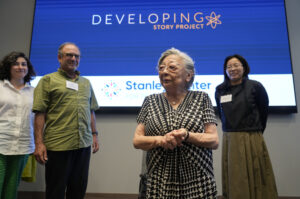
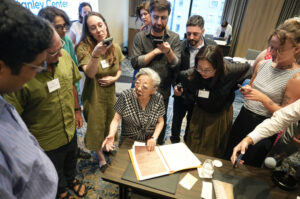
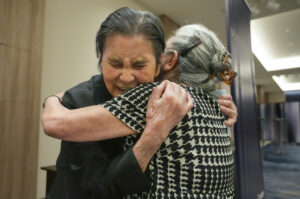
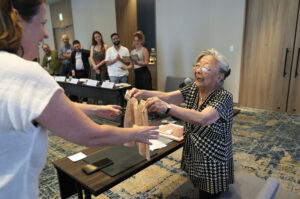
Clockwise from top left: Koko Kondo, center, describes her experience as an atomic bomb survivor. Kondo displays copies of the letters her father wrote to American journalist John Hersey, who would feature him in Hersey’s groundbreaking account of the aftermath of the bombing. Kondo holds up the shirt she was wearing on August 6, 1945, when she was 8 months old. Survivor Chieko Kiriake and Kondo embrace after offering their testimonies.
The cohort then met with the Governor of Hiroshima Prefecture, Yuzuki Hidehiko, who talked about his work to abolish nuclear weapons and took many questions from workshop participants. Two weeks before this meeting, he had delivered a speech at the official 80th anniversary memorial ceremony, where he urged attendees to move “persistently towards the light of nuclear abolition, ensuring the lives and security of the human race and the earth.”
During peer exchange sessions, participating journalists shared a behind-the-scenes view into how they reported a nuclear story from concept to publication. Another session focused on mapping story ideas over the next year, thinking about reporting opportunities beyond breaking news moments.
Participant Eva Krysiak, a senior audio producer and storyteller, remarked, “The most valuable part was our collaborative work – mapping story gaps across our countries, developing concrete pitches, and analysing case studies from colleagues in different regions. As someone who’s always been drawn to unexpected stories in unexpected places, these exercises showed me how to humanise complex narratives for audiences with varying exposure to nuclear themes.”
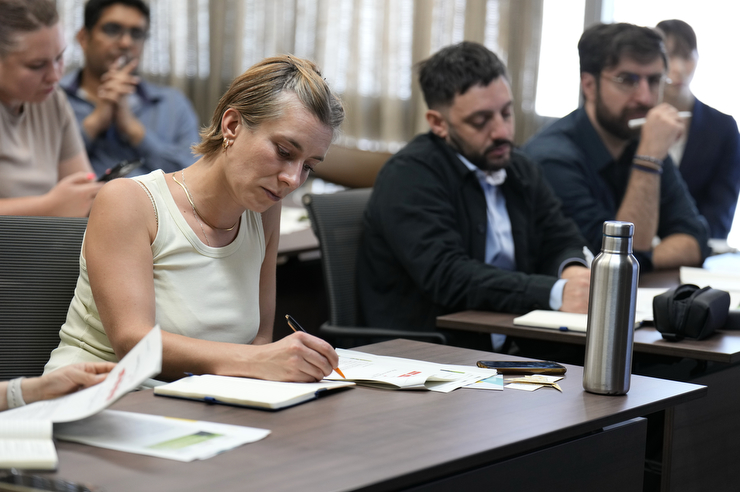
Eva Krysiak, left, during remarks from the Governor of Hiroshima Prefecture, Yuzuki Hidehiko, a proponent of abolishing nuclear weapons.
During the ‘Dial an Expert’ segment, members of the cohort had a chance to join a breakout room via video with an issue area expert of their choice. Participants had an hour to hear from an expert (in proliferation, emerging tech, or treaties) and ask them any questions that came to mind without the pressure of a looming publication deadline.
After dinner on the third day of the workshop, participants reconvened at a local cinema for a world-first screening of Bombshell, a documentary about US government efforts to control the narrative of the atomic bomb after its use in Japan. Director Ben Loeterman and Masakatsu Ota, a Kyodo News journalist and author of ten books about nuclear weapons, had a rich discussion following the film and took questions from viewers. To make the event accessible to a local audience, the film included Japanese subtitles, and a local interpreter was on hand for the discussion and Q&A.
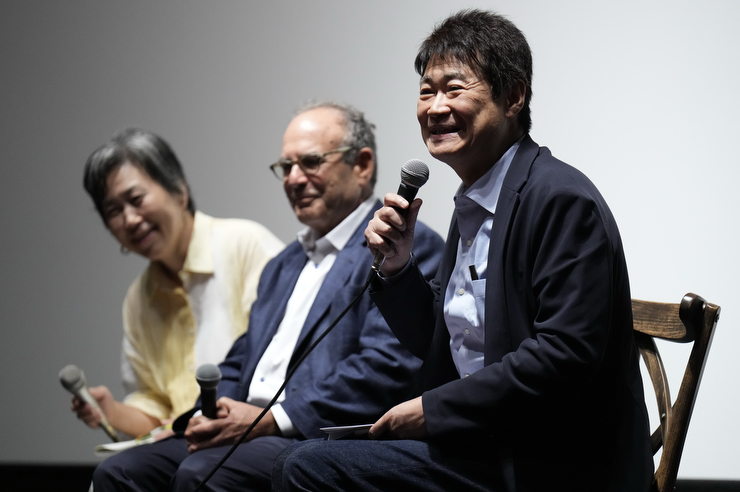
From left, interpreter Mariko Komatsu, director Ben Loeterman, and journalist Masakatsu Ota take questions from the audience after the screening of Bombshell.
The cohort met local journalists and learned about their current reporting on nuclear issues during a visit to the offices of Chugoku Shimbun, the Hiroshima area’s major daily paper, which lost a third of its staff in the atomic bombing 80 years ago. One of the first photos of the Hiroshima mushroom cloud was taken by a Chugoku Shimbun photojournalist, and the paper has continued to cover the story of nuclear weapons and their aftermath ever since.
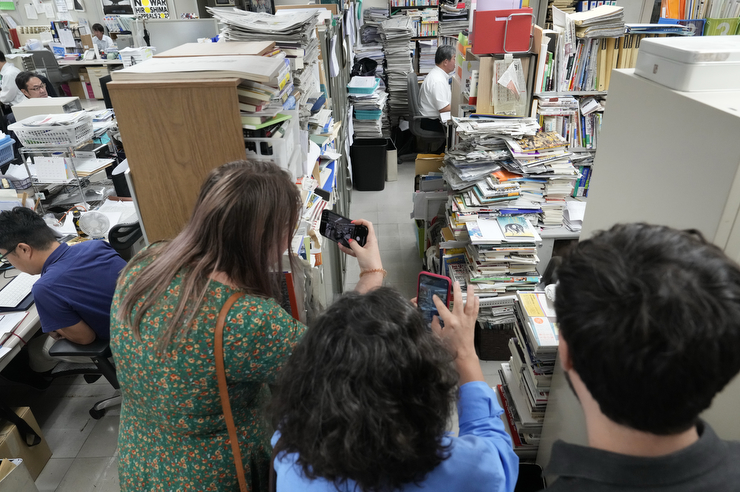
Cohort journalists document their visit to the newsroom of the Chugoku Shimbun.
The group of journalists spent several hours at the Peace Memorial Museum, an extremely evocative and moving collection of artifacts, art, and information about the effects of the atomic bombing. This was followed by small-group tours of Peace Memorial Park, including the children’s monument, the eternal flame, and the cenotaph, whose inscription reads, “Let all the souls here rest in peace; For we shall not repeat the evil.”
Davison noted, “It was incredibly moving: from listening to elderly survivors (Hibakusha) speak with conviction about the importance of a nuclear free world, to walking past trees that survived the blast, to meeting Japanese journalists that have covered this story since the day of the bombing.”
The gravity of the subject matter of the journalism workshop alternated with more lighthearted moments. There was a nuclear weapons pop quiz segment, where across multiple rounds, including a popular culture round, participants tested their knowledge of nuclear weapons technology, history, and policy. Winners received Hiroshima Toyo Carp gear so they can represent the local baseball team in their home countries.
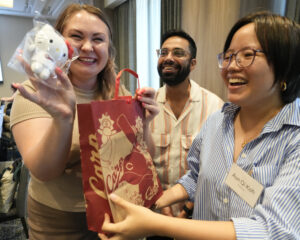
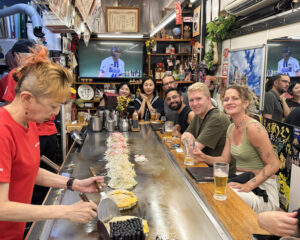
From left, Kateryna Malofieieva, Karan Deep Singh, and Aun Qi Koh celebrate their win during the nuclear weapons pop quiz. Workshop participants enjoy Hiroshima-style Okonomiyaki, a local favorite, during a small group dinner. (Photo credit: Stanley Center)
Group dinners offered participants a chance to savor Japanese cuisine and build bonds with one another. Krysiak says that she “discovered [that my cohort of talented journalists] are as adept at unpacking nuclear policy by day as they are at dominating the karaoke booth at night…”
The Developing Story Project’s Hiroshima Journalism Workshop helped reporters from around the world connect and collaborate with one another in a community of practice.
Participant Kyung Jin Kim, a TV journalist covering foreign affairs and security, said:
“It was five unforgettable days of learning and exchanging ideas. Talking about the same theme—nuclear weapons—but through the perspectives of Europe, Japan, and the U.S. was truly eye-opening… This week gave me fresh energy and new ways of thinking, and I hope to carry that back into my work in Korea.”
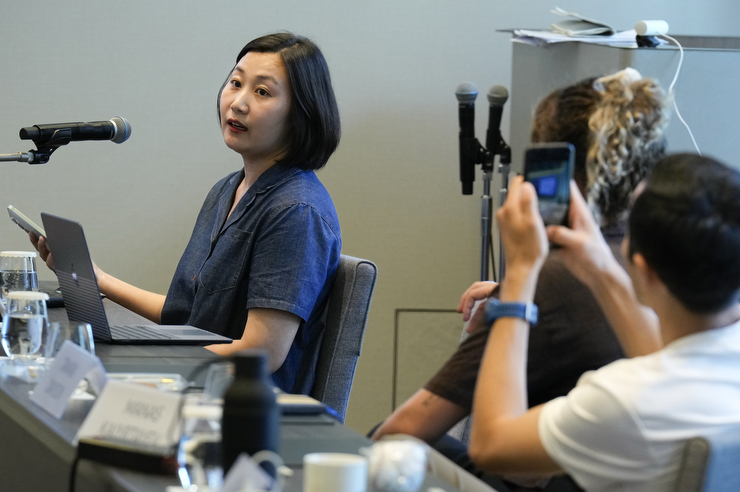
Kyung Jin Kim presents to workshop journalists about her experience reporting on North Korea’s nuclear weapons program.
Krysiak reflected that “I come away eager to keep learning and to explore reporting on how military build up and nuclear proliferation affect communities, before those impacts reach a crisis point.”
In the months to come–and indeed already–the shared experiences gained during this Developing Story Project event will be reflected in the reporting of the participating journalists and editors. “I’m very excited to use my new knowledge and publish a series of investigations into Europe’s burgeoning nuclear weapons industry,” said investigative journalist Dylan Carter, a member of the cohort.
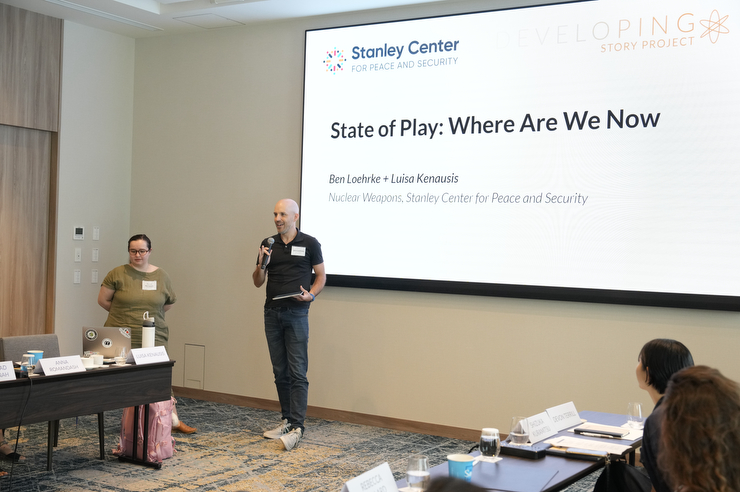
Workshop participants had the opportunity to be briefed by nuclear weapons experts from around the world, learning about the role of emerging technology and the status of nuclear treaties.
For at least one of the participants, Dain Oh, being a part of the Hiroshima Journalism Workshop “came at exactly the right moment” in her career:
The Stanley Center’s journalism and media team is grateful to all of the people who made the first in-person workshop of the Developing Story Project such a deeply meaningful experience. The organizers have gathered a long list of ideas for building and supporting a peer network of journalists reporting on nuclear weapons issues and look forward to many more DSP events to come.
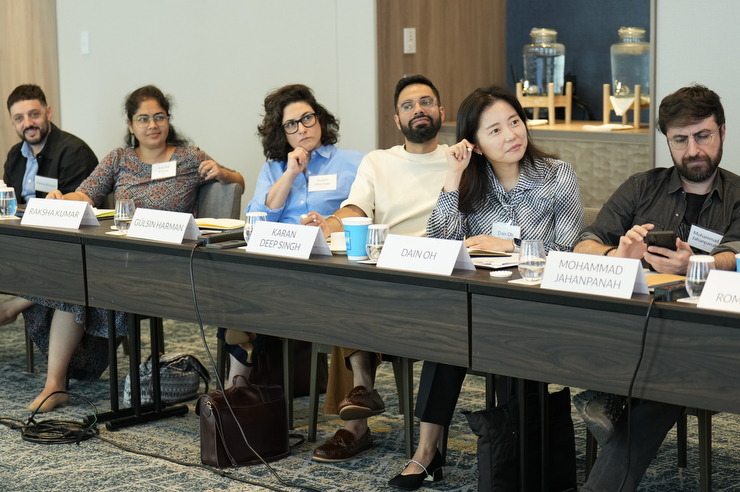
Workshop sessions explored the gaps in coverage of nuclear weapons and helped participants brainstorm ways to fill them. Dain Oh, center right, responds during a workshop presentation.
Related Stories
View All