
Nuclear Weapons
Developing Story Project expands to include journalism students
With screenings of the new documentary Bombshell, the Developing Story Project engages the next generation of journalists and media-makers to take on the necessary challenge of rigorous reporting on nuclear weapons.
Top photo: General Leslie R. Groves (center left), Chief of Manhattan Engineering District, in which the first atomic bomb was developed, holds his first press conference in Oak Ridge, Tennessee, after dropping the atomic bomb. (Credit: Department of Energy, photo by Ed Westcott)
In 2026, the Developing Story Project will kick off a series of screenings of the documentary Bombshell in partnership with journalism schools across the country as part of an effort to bring journalism students and early career journalists into the Developing Story Project community. Screenings will be accompanied by discussions with the filmmaking team, students, journalism scholars, and nuclear weapons experts.
Bombshell, directed by Ben Loeterman, is a feature documentary examining how, at the dawn of the nuclear age, the US government constructed an appealing yet false “official” narrative about the atomic bombings of Hiroshima and Nagasaki—one that secured overwhelming public support and endures to this day. Through propaganda, censorship, and co-opting the press, the atomic bomb was presented as an incredible scientific achievement and industrial feat that could end the war. In this narrative, the bomb’s radiation poisoning and its insidious lingering effects were minimized or altogether erased.
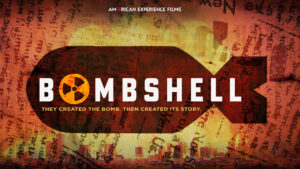 Bombshell traces how this narrative was initially shaped by a New York Times reporter working undercover for the Manhattan Project. It then profiles several journalists whose first-hand reporting daringly challenged the official narrative. The journalists included a war correspondent for the Black press, a Japanese American staffer at United Press (later UPI), an Australian freelancer, a Chicago Daily’s foreign correspondent, and a hesitant magazine writer and novelist named John Hersey. Taken together, their hard-won stories about civilian suffering and the long-term radiation effects the government denied demonstrate what is lost when independent journalism is suppressed, and truth bends to power.
Bombshell contains powerful lessons for today’s journalists. As the Pentagon attempts to restrict information about military programs during a time of massive expansion of the nuclear weapons budget, journalists have a crucial role to play: bringing facts and human stories to light, so that the public may have an accurate understanding of the ongoing risks and harms posed by nuclear weapons.
The Stanley Center’s journalism and media program is screening Bombshell at key events to raise awareness and inspire thought and action among journalists and journalism students. Programs organized by the Developing Story Project help equip participants with the knowledge, skills, resources, and relationships they need to effectively report on nuclear weapons.
The film has already had two successful screenings in partnership with the Stanley Center: first in Hiroshima last August during the commemorations of the 80th anniversary of the use of the bomb there, and the second in Vienna last November during the International Press Institute’s World Congress. Both events sparked thoughtful conversations with journalists and students about press freedom, ethics, and responsibility.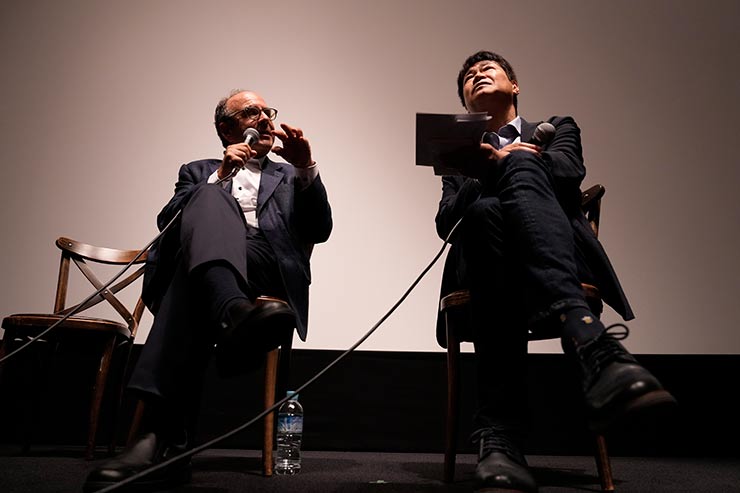
Director Ben Loeterman, left, and journalist Masakatsu Ota discuss after the screening of Bombshell in Hiroshima, Japan, August 2025.
The Stanley Center for Peace and Security’s Developing Story Project is a multi-year initiative to support, strengthen, and sustain reporting on nuclear weapons and related issues. The project supports journalists around the world through a variety of training, workshops, fellowships, networking events, film screenings, dialogues, and reporting trips organized in collaboration with various partners, including the European Journalism Center, the International Press Institute, Atomic Reporters, the Bulletin of the Atomic Scientists, and the Asia chapter of the Asian American Journalists Association.
Sign up to receive nuclear weapons journalism and media updates by email to stay up to date on opportunities from the Developing Story Project.